
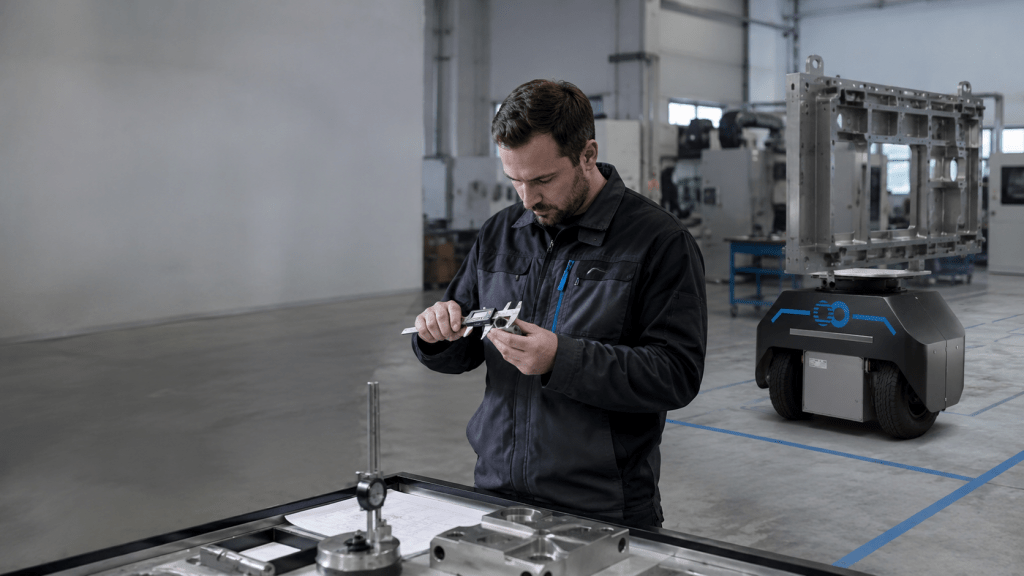
In many workshops, manual handling has become such a routine part of the process that it is no longer considered an operation in its own right.
Teams move a frame, push a support, orient a tool, wait for a colleague, realign a structure and then return to their actual work.
These steps can seem inseparable from the job. Yet they do not always call on the expertise for which operators are truly essential.
Reducing manual handling does not mean removing people from the process.
It means distinguishing:
- the effort needed to move the structure;
- the decision to start the operation;
- control of the load;
- supervision of the route;
- handling exceptional situations.
A task can be assisted or automated without eliminating the operator’s role, responsibility or decision-making ability.
The question is therefore not just:
“How else can this structure be moved?”
It is also:
“Which functions should remain human, and which tasks can a system handle?”
A manual task is not necessarily a high-value task
An operation may have been manual for years without anyone reassessing that choice.
Handling may have gradually become part of the daily routine:
- an operator pushes the structure to the next workstation;
- a colleague helps it through a passage;
- a third person helps with alignment;
- the team waits for material-handling equipment to become available;
- work resumes once the structure is finally positioned.
This arrangement works, but it uses skilled people for a function that is mainly about movement.
The operator remains essential to prepare the part, inspect the tooling, check conformity or decide the next step. But they may not need to provide the physical force to move it.
The first step is therefore to separate the professional work from the handling around it.
The fact that an operator is essential to the process does not mean every action around that process has the same value.
Automating a task does not mean replacing a profession
Automation is often framed as a choice between two extremes: an operation performed entirely by a person or entirely by a machine.
In industrial reality, responsibilities can be divided far more gradually.
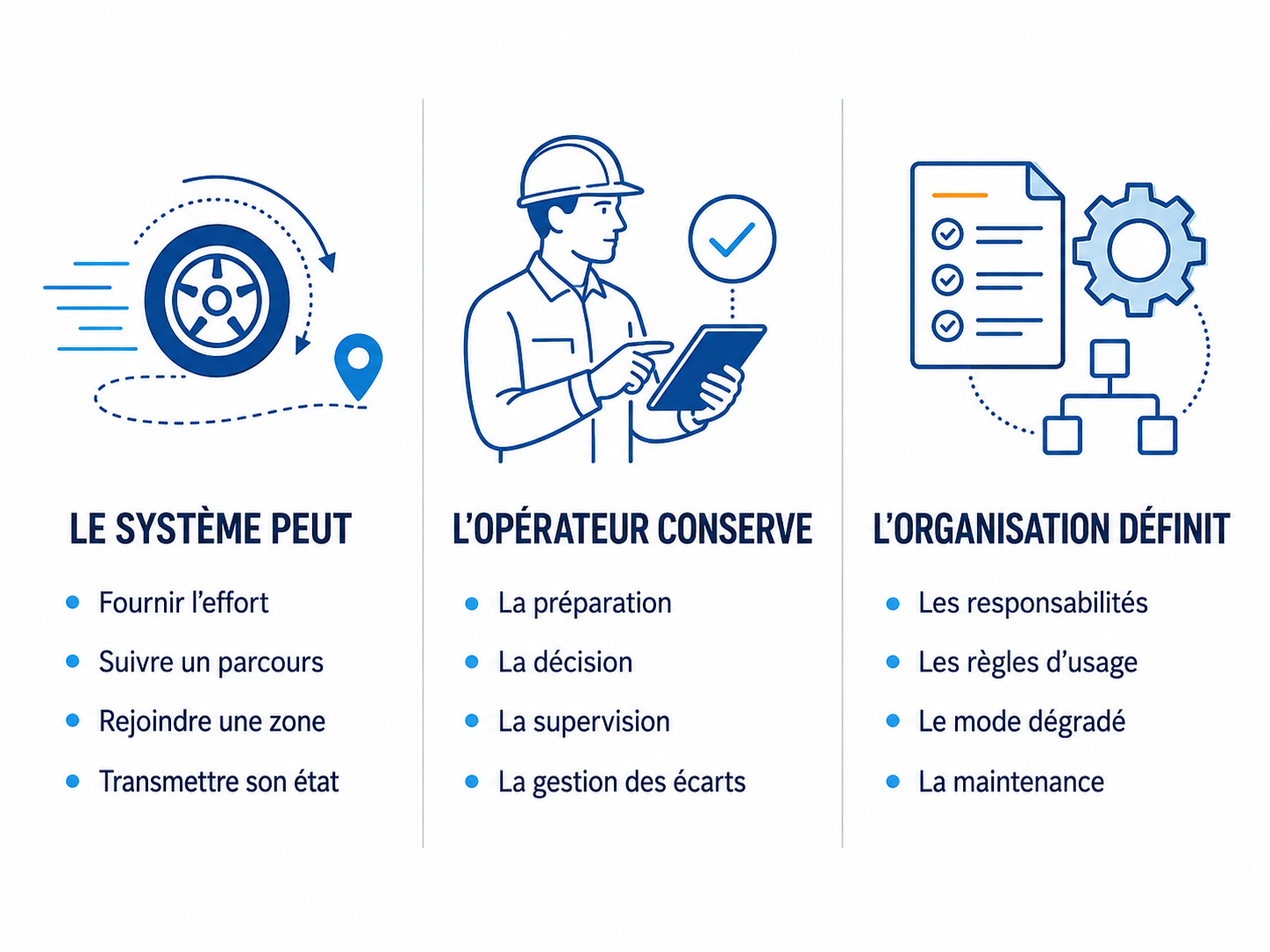
Distinguishing the task, decision and responsibility
Moving a structure is a task.
Deciding that it is ready to leave is a decision.
Checking its load, confirming arrival and addressing an anomaly are different responsibilities.
These functions should not be confused.
A system can provide the force, follow a route or reach an area, while the operator retains:
- preparation;
- authorization;
- supervision;
- final inspection;
- handling deviations.
Preserving on-site expertise
Operators know the details of the real operation.
They can recognize:
- an unevenly distributed load;
- an unusual point of contact;
- a temporarily obstructed area;
- an abnormal sound;
- an incomplete fastening;
- a situation that calls for stopping the process.
Such information is rarely visible in a theoretical diagram.
Automating without this expertise risks creating a technically functional system that is difficult to use.
Redefining the role rather than removing the human presence
The human role can evolve without disappearing.
The operator can remain responsible for:
- preparing the structure;
- checking its stability;
- authorizing the mission;
- choosing the destination;
- supervising movement;
- confirming arrival;
- intervening when a situation falls outside the expected conditions.
The system then handles the movement function without taking control of the process away from the team.
Which handling tasks should be assessed first?
Not every manual operation calls for assistance or automation.
The first operations to assess are those with a recurring, observable constraint.
Repetitive movements
A movement repeated along an identifiable route is a good starting point for analysis.
Repeatability makes the operation easier to describe, but does not alone justify automation.
You also need to understand the load, variations, decisions required and exceptional situations.
Maneuvers that require several people
Some structures require several people mainly to provide force, maintain visibility or coordinate orientation.
In that case, the question is whether all of them truly need to be involved throughout the maneuver.
Operations that vary with the load or environment
A structure may be easy to move when empty and become difficult when:
- its mass increases;
- its center of gravity shifts;
- the floor is uneven;
- the passage narrows;
- greater precision is required;
- other activities occupy the area.
Document this variability before choosing a solution.
Tasks that interrupt the main activity
Handling becomes especially visible when it forces an operator to leave productive work, find a colleague or wait for a vehicle.
The organizational cost then extends beyond movement time. It includes the interruption, resumption and coordination required.
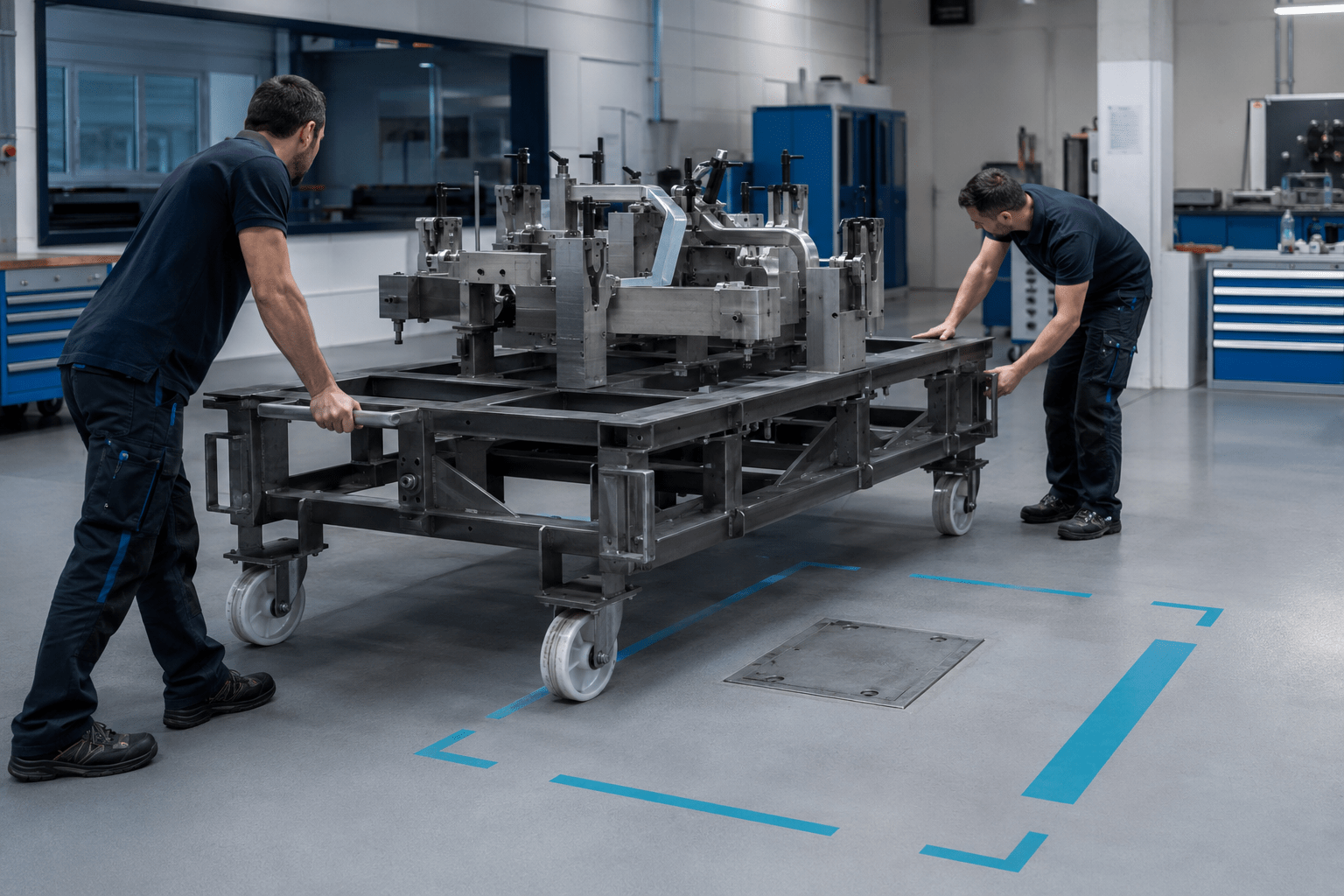
These situations can often be seen before a technical study: spotting the signs that a structure is already limiting production helps select the operation to observe first.
Observe the operation with the teams
A useful study starts on site, with the people who actually perform the handling.
The goal is not simply to time a route.
You need to understand the whole cycle and the decisions made along the way.
Follow a complete cycle
Observe, in sequence:
- preparation;
- taking control;
- departure;
- movement;
- waiting;
- turns;
- arrival;
- alignment;
- securing the structure;
- resuming work.
Transfer time does not start only when the structure begins to roll. It starts when the previous operation stops and ends when the next can actually resume.
Document normal and exceptional situations
Observations should include:
- a different load;
- an obstructed passage;
- an unavailable destination;
- a need to reverse course;
- a fault;
- an interruption;
- maintenance intervention;
- the absence of someone normally called upon.
A solution designed only for the ideal scenario may be difficult to use day to day.
Listen to informal strategies
Teams often develop ways to make the maneuver possible:
- a floor mark;
- a change of grip;
- a detour;
- a signal between colleagues;
- a particular way to approach a turn;
- a correction before arrival.
These practices should not be ignored.
They often reveal the constraints the future solution must address.
Start with a real operation
Select a recurring movement and document the load, route, people involved, human decisions and exceptional situations.
Clearly assign roles
Automation does not automatically assign responsibilities.
These must be explicitly defined before deployment.
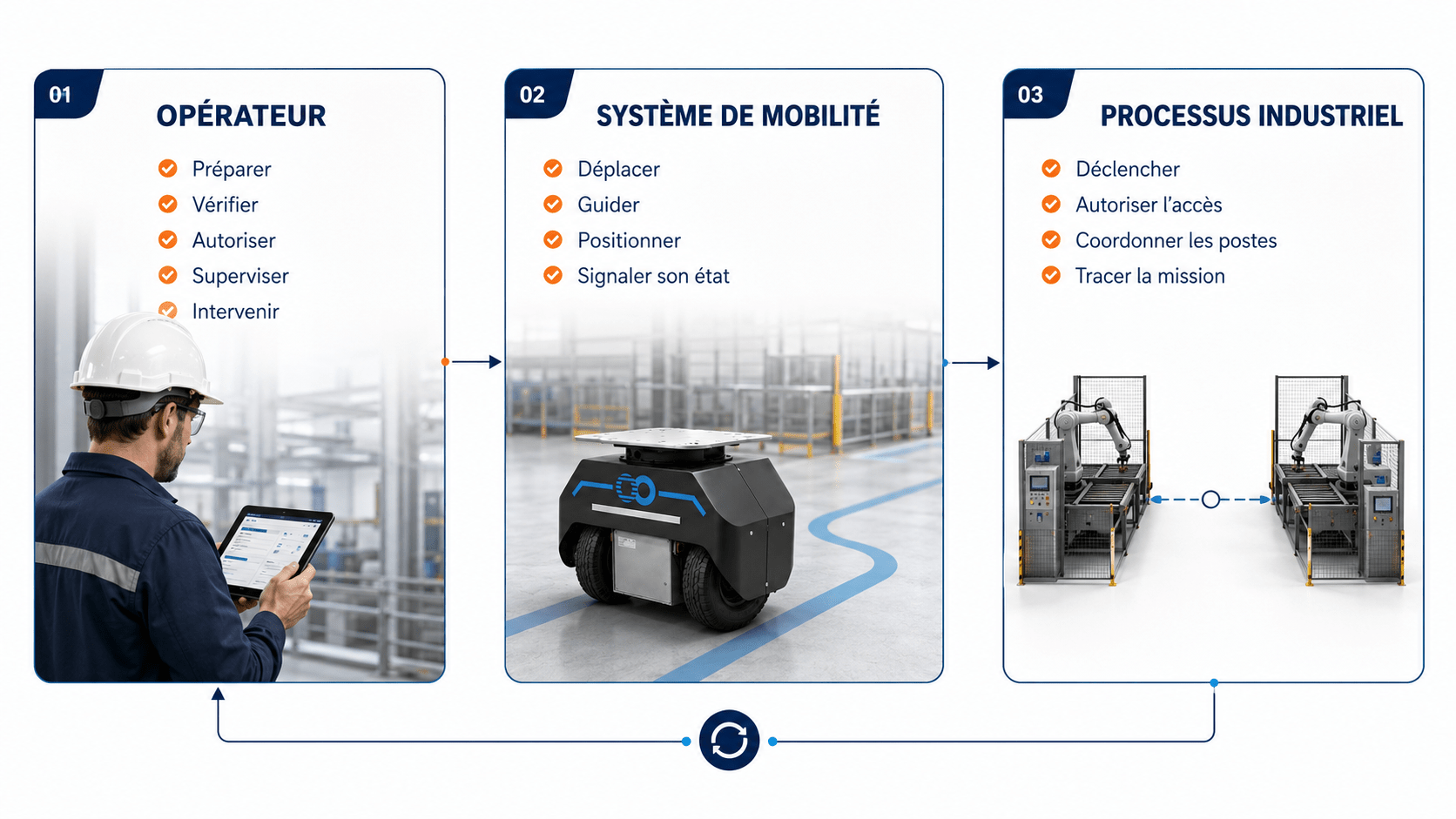
What the operator can retain
The operator may:
- prepare the load;
- check stability;
- authorizing the mission;
- choosing the destination;
- supervise;
- confirm arrival;
- handle exceptions.
What the system can handle
Depending on the level of automation, the system may:
- provide the force;
- move the structure;
- follow a path;
- reach an area;
- assist positioning;
- report its status.
What the organization must define
The company must define:
- rules of use;
- responsibilities;
- authorizations;
- required checks;
- fault handling;
- maintenance;
- training;
- fallback operation.
Technology must not leave a gray area between what the system performs and what teams need to check.
Choose an appropriate level of assistance
Not every handling task needs full autonomy.
The appropriate level depends on the operation, environment and the role teams need to retain.
Movement assistance
The operator remains directly involved in the maneuver.
The system reduces effort or facilitates movement without completing the whole mission by itself.
This approach can suit variable routes or operations requiring constant human judgment.
Control and supervision
The operator commands or approves the movement without pushing the structure directly.
They can choose a position with better visibility while retaining responsibility for the maneuver.
Automated mission
The system carries out a defined operation in an assessed environment.
The operator prepares the load, authorizes the mission, supervises it and intervenes when the situation requires.
The most automated level is not automatically the best.
The right solution reduces the constraint without making the process unnecessarily complex.
The approach echoes a question already explored for existing structures: choosing the right level of automation means selecting the level that solves the problem without adding unnecessary complexity.
Test with operators before wider rollout
A proof of concept should do more than show that a structure can move.
It should verify that the system can be used, understood and taken over manually under real conditions.
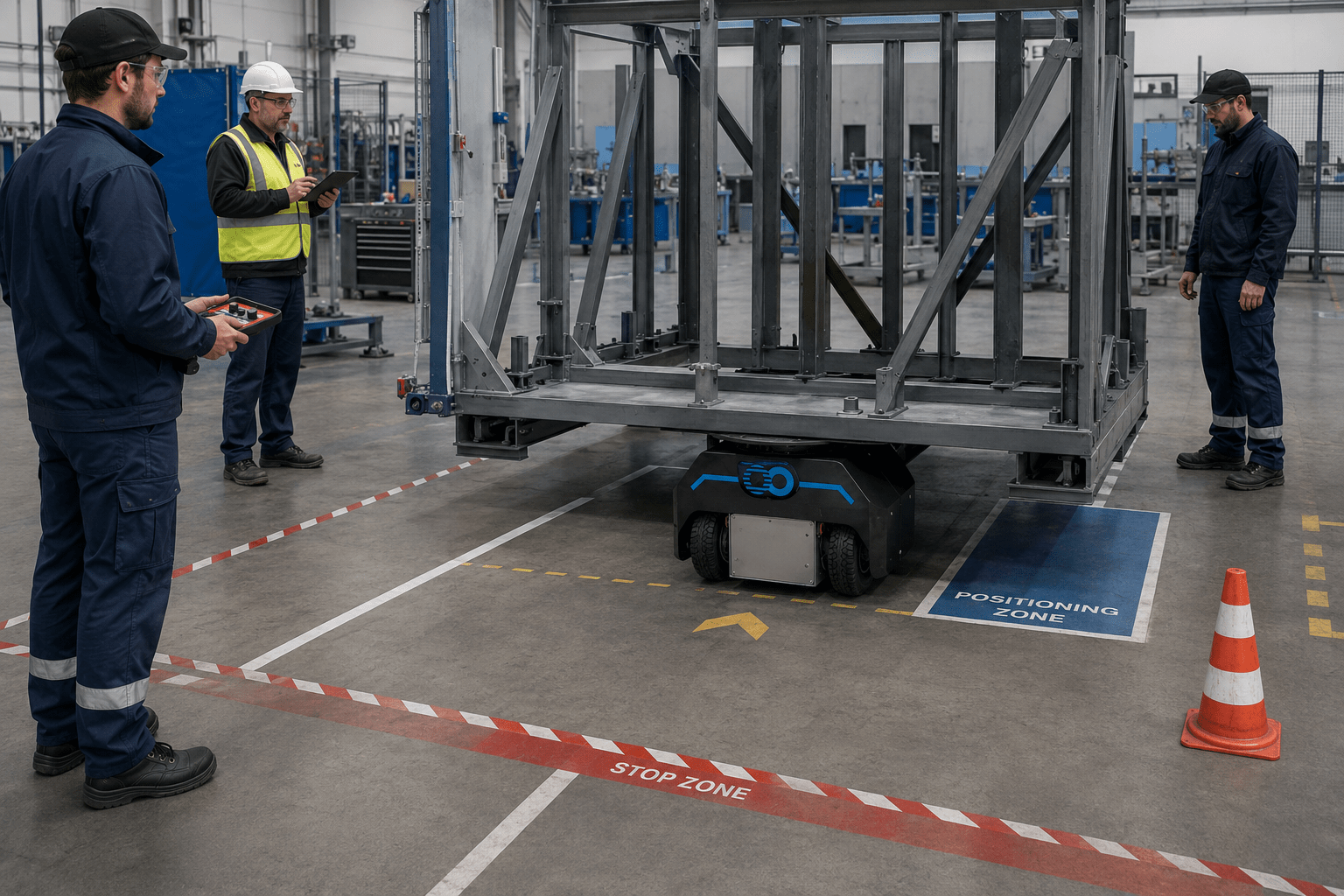
The test should include:
- a representative load;
- the most constrained passages;
- stopping areas;
- positioning on arrival;
- controls;
- stopping and restarting;
- fallback operation;
- access to the structure;
- interactions with teams.
Operators should be able to say:
- what genuinely makes the task easier;
- what remains difficult;
- what is missing;
- what creates a new constraint;
- what needs clarifying before deployment.
Illustrative hypothetical example
A metal structure is moved several times a day between a preparation workstation and a machine.
Before the study:
- two people move the structure;
- a third may be needed for alignment;
- the transfer temporarily interrupts other activities.
In an assisted setup:
- the system provides the movement;
- an operator prepares and authorizes the transfer;
- the operator supervises its arrival;
- the team intervenes only when needed.
This example is hypothetical.
It does not represent a customer project, measured performance or guaranteed savings.
Points of caution and limitations
Reducing manual handling should not merely shift the constraint to another stage.
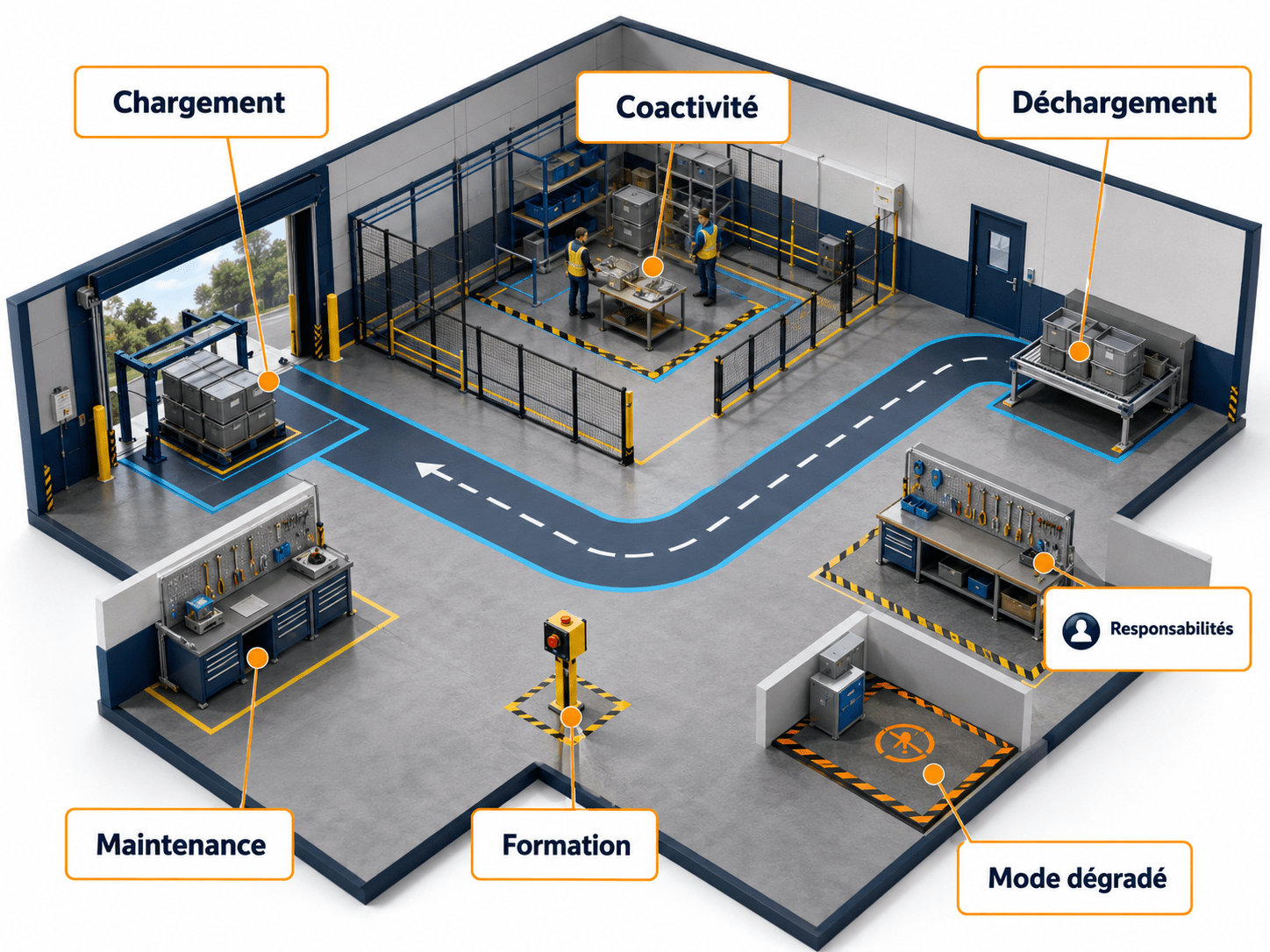
A structure that is easier to move may still be difficult to load, unload, lock or maintain.
The project must therefore check:
- load preparation;
- loading;
- unloading;
- access to inspection points;
- shared working areas;
- responsibility for authorizations;
- fallback operation;
- training;
- maintenance;
- the ability to regain manual control.
It is also important not to automate a poorly defined operation.
If destinations, responsibilities or rules change every cycle, the first improvement may be organizational rather than technological.
Keeping an operation manual may remain appropriate when:
- the operation is very rare;
- the load is light and easy to move;
- the route changes constantly;
- human judgment is needed at every moment;
- the environment cannot be controlled sufficiently;
- the solution would be more complex than the task;
- no clear organizational benefit can be identified.
A serious study must be able to conclude that automation is not the best solution.
Checklist before reducing manual handling
Before consulting an integrator or comparing technologies, answer these questions:
- Which structure is being moved?
- What load does it carry?
- What main task must the operator interrupt?
- How many people are actually needed?
- Which part of the operation requires human expertise?
- Which part mainly involves physical movement?
- Is the route repetitive?
- What variations occur?
- Which passages are most constrained?
- What positioning accuracy is required on arrival?
- Who should authorize departure?
- Who should check the load?
- Who should supervise the mission?
- What happens if there is an obstacle or stoppage?
- How can the structure be cleared?
- Which skills must be preserved?
- How will operators participate in testing?
- How will you check that the constraint has not simply moved to another stage?
This checklist does not produce an automatic score.
It helps prepare an on-site observation and clarify how functions will be divided in the future.
Reduce physical effort without removing human intelligence
Reducing manual handling does not mean removing teams from the workshop.
It means dividing functions more effectively:
- the system provides the movement;
- the operator retains expertise;
- the organization defines responsibilities;
- the project plans for normal and exceptional situations.
Good automation does more than move a structure.
It should give teams more time for tasks that truly require:
- their judgment;
- their experience;
- their oversight;
- their ability to adapt.
We do not replace teams.
We aim to stop them spending their expertise on movement tasks that can be handled another way.
More on-site insights are available in the FreeMoov Resource Center.
Let’s study a handling operation with your teams.
Tell us about the structure, load, route, people involved and functions that must remain under human control. The FreeMoov team can assess an appropriate level of assistance or automation.