
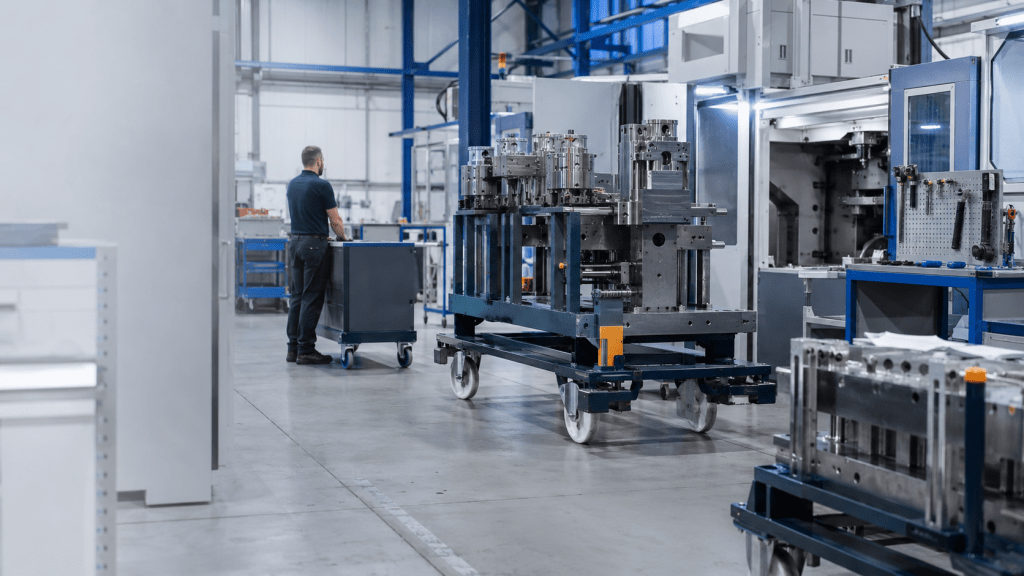
An industrial structure can be robust, perfectly maintained and still suited to its mechanical purpose. Yet it can also gradually slow production.
The problem does not necessarily lie in its design. The organization around it may have changed: new production rates, altered routes, more product references, less available space, a change of workstation or a need for automation.
The structure still works, but moving it no longer matches the pace of operations.
This situation is often hard to detect. There is not always a breakdown, sudden stoppage or clearly identifiable incident. Instead, losses show up as small waits, repeated maneuvers, temporary fixes and movements that add no value.
Here are seven signs to look for on the shop floor before considering a major overhaul of the installation.
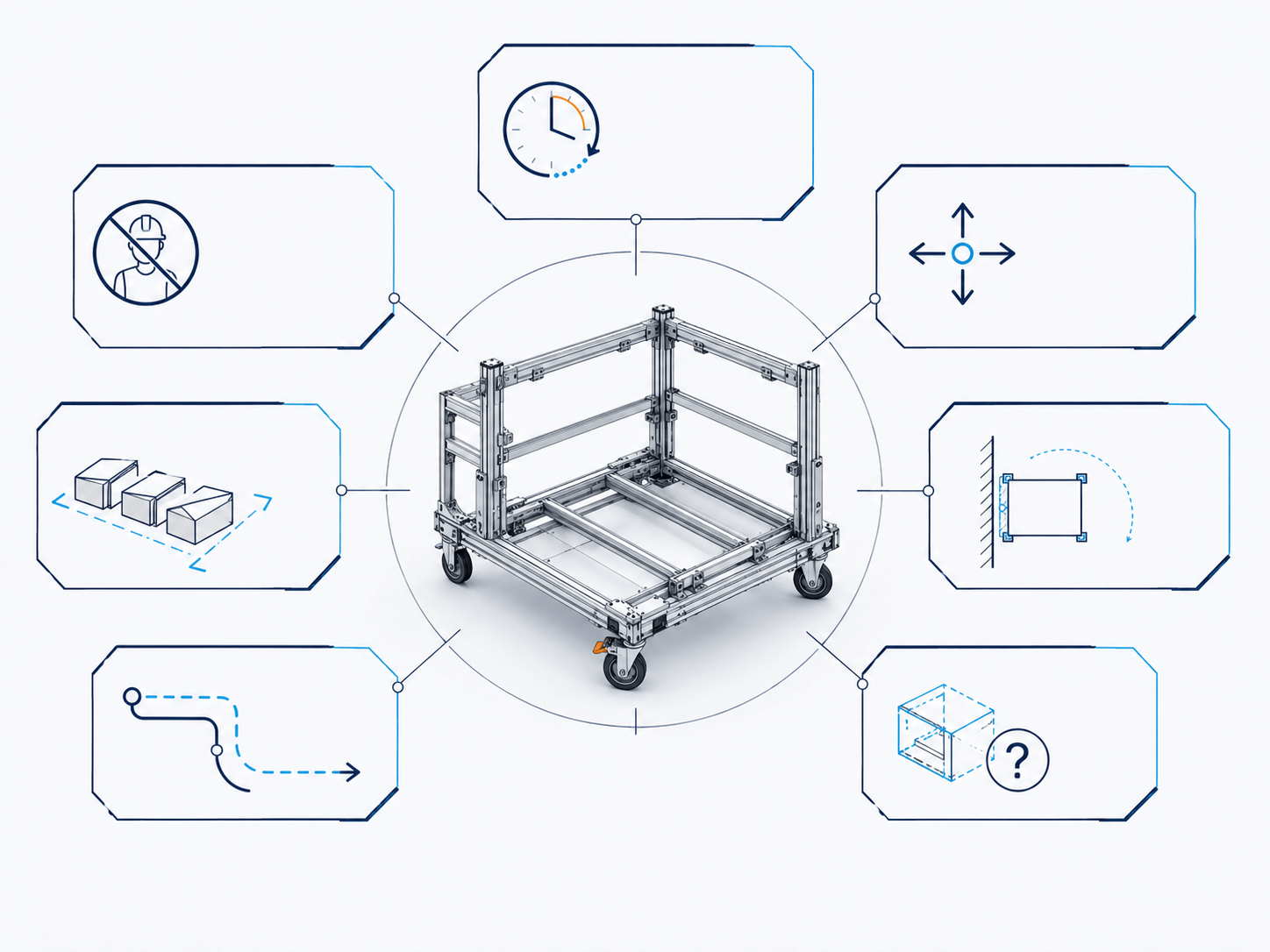
- Transfer takes too long
- Dependence on a resource
- Repeated repositioning
- Buffer zones
- Lack of flexibility
- Inconsistent maneuvering
- Unnecessary replacement considered
A structure may work properly yet still limit flow
The mechanical condition of equipment and its operational suitability are two different questions.
A frame, support, cradle or mobile tool can perform its main function well while becoming difficult to move between operations.
This can happen when a plant evolves around equipment that remains unchanged:
- production rates increase;
- workstations are reorganized;
- distances grow;
- loads become more variable;
- production runs become shorter;
- configuration changes multiply;
- circulation space shrinks.
In this context, the structure does not necessarily become obsolete. Sometimes it is the way it is moved that no longer meets actual needs.
The first step is therefore to separate three aspects:
- the function performed by the structure;
- how it is moved;
- how it integrates into the overall flow.
7 signs to look for on the shop floor
1. A simple transfer takes almost as long as the productive operation
The first sign appears when the time around a transfer becomes disproportionate to the operation itself.
The structure must be prepared, released, moved, turned, aligned and secured before work can resume.
Some of that time is spent:
- clearing the way;
- finding material-handling equipment;
- waiting for someone to become available;
- performing several maneuvers;
- correcting the position on arrival;
- securing the structure again.
Individually, each step may seem minor. Repeated several times a day, however, they can disrupt the continuity of the flow.
The right question is not just: “How long does the transfer take?”
You need to measure the entire time between the end of one operation and the actual start of the next.
2. Flow depends on the availability of a person or material-handling equipment
A structure becomes a constraint when moving it can begin only once a resource outside the process arrives.
You may have to wait for:
- a forklift operator;
- a tow tractor;
- a suitable trolley;
- an overhead crane;
- a second operator;
- someone who knows the maneuver in detail.
The problem does not lie with the teams. It lies in the dependency created by the organization.
The person or vehicle needed often has other priorities. The structure then waits for that resource to become available, even when the next workstation is ready.
This gap can lead to informal coordination: calls, messages, searching for someone, or constant trade-offs between competing needs.
When a recurring operation depends on uncertain availability, it is worth reviewing how the structure is moved.
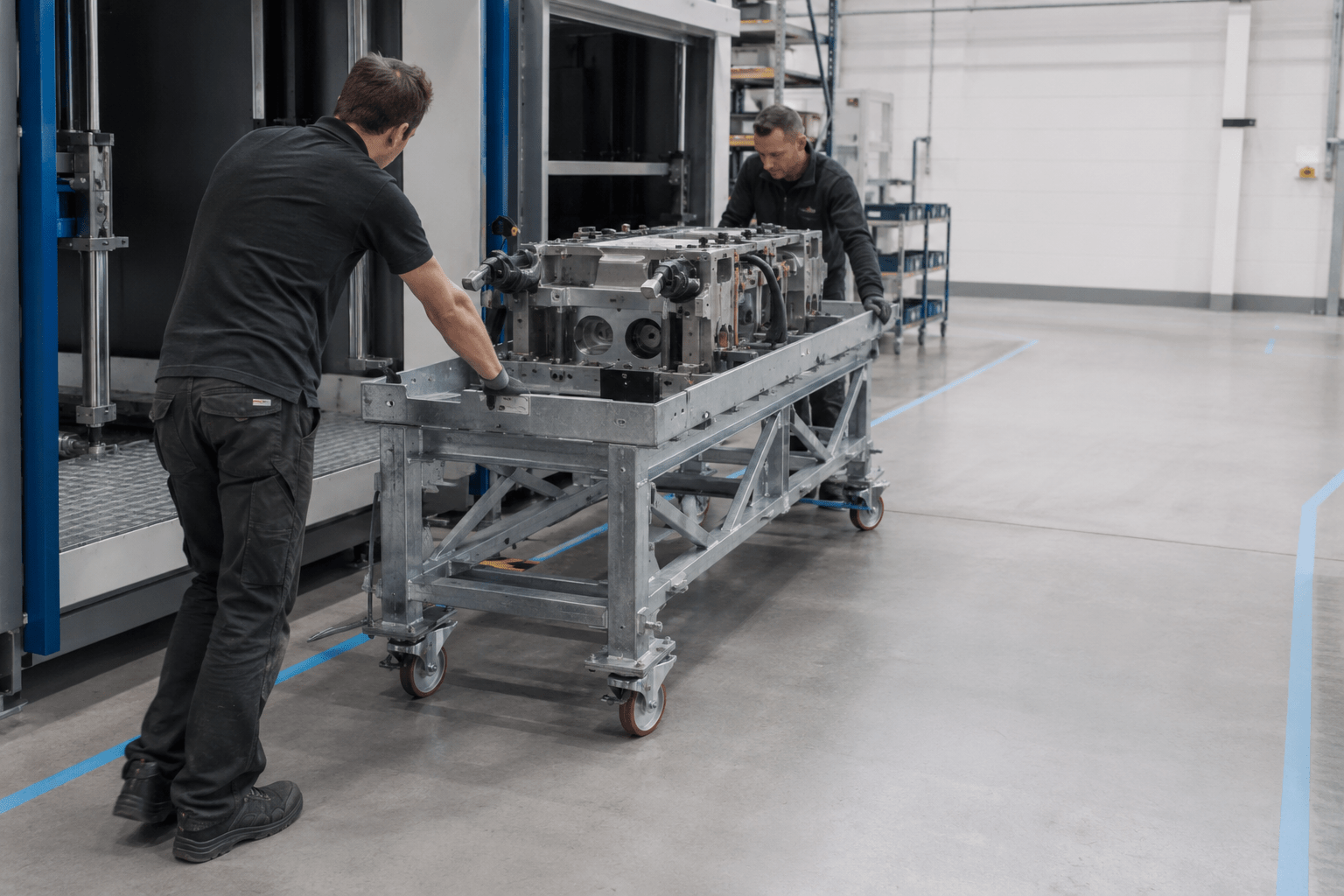
3. The structure has to be pushed, pulled, turned and realigned several times
Some structures can be moved manually, but only after several corrections.
The maneuver may require:
- an initial push to leave the workstation;
- a turn in an aisle;
- a change of grip;
- a lateral correction;
- help from a second operator;
- precise realignment on arrival.
The structure eventually reaches its destination, but the route remains irregular and hard to repeat consistently.
This is especially noticeable when space is limited, the load affects the behavior of the casters, or the interface with the workstation requires precise positioning.
Count the number of handling steps needed for a complete transfer, not just the distance traveled.
4. Buffer zones appear to compensate for transfer delays
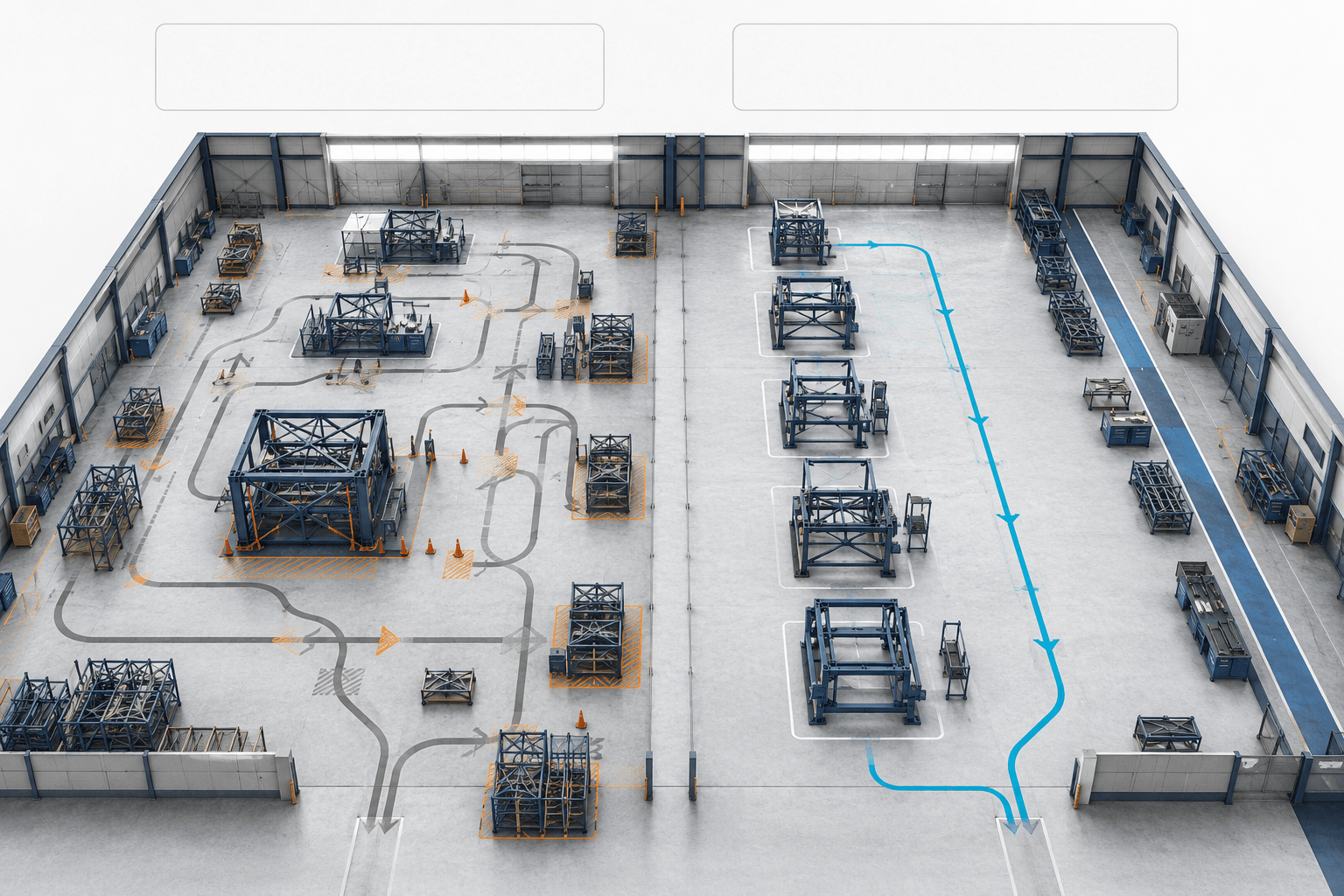
A buffer zone can be useful in an industrial process. It becomes a warning sign, however, when it mainly exists to absorb transfer delays.
Structures are then left temporarily:
- in front of a workstation;
- in an aisle;
- near a machine;
- in space originally intended for circulation;
- in a waiting area that gradually grows.
This arrangement keeps the process moving, but it does not remove the cause of the delay.
It can also make the flow harder to understand: more work in progress, time spent finding the right structure, additional movements or blocked routes.
The question is simple:
“Is this buffer zone necessary to the process, or is it compensating for movement that is too slow or poorly synchronized?”
Want to measure the problem objectively?
Observe a complete cycle: preparation, waiting, transfer, positioning and resumption of work. The checklist at the end of the article will help structure your observations.
5. Every product changeover or layout change calls for a temporary workaround
A structure may be perfectly suited to one configuration, yet become difficult to use as soon as the flow changes.
With each change, teams must find a new solution:
- add an intermediate trolley;
- temporarily change the route;
- move the structure with oversized equipment;
- fit additional casters;
- call on several people;
- create temporary storage;
- realign it manually.
These adaptations suggest that the structure lacks flexibility rather than strength.
The issue often appears in workshops with product changeovers, variable production or frequent layout changes.
A solution designed for a fixed route can quickly become restrictive as its environment evolves.
6. The effort, precision or safety of the maneuver varies greatly with conditions
A maneuver may seem simple when empty and become much harder when the structure is loaded.
Its behavior may vary according to:
- the mass carried;
- the load distribution;
- the floor condition;
- the slope;
- the width of the passage;
- obstacles;
- visibility;
- congestion in the area;
- the number of people available.
Variability is an important indicator.
When a successful transfer depends too heavily on conditions or the operator’s experience, the process becomes difficult to standardize.
This does not mean that technology will automatically eliminate risk. Any change must be assessed against the load, environment and operation involved.
The aim is to identify situations in which the maneuver is no longer consistent or predictable enough.
7. You are considering replacing a useful structure solely because it cannot fit into an automated flow
The final sign appears when a still-functional structure is considered obsolete solely because it cannot move autonomously or fit into a new organization.
Yet this structure may still have several strengths:
- it is mechanically suited to the task;
- it carries specialized tooling;
- teams know and understand it;
- it meets the product’s requirements;
- it is already integrated with existing workstations.
Replacing it could therefore mean rebuilding not only the structure but also its interfaces, fixing points or part of its environment.
Before starting such a change, another question deserves consideration:
“Do you really need a new structure, or a new ability to move?”
What these signals really reveal
A mobility problem
The structure does its job, but it does not arrive at the right place at the right time.
A synchronization problem
Its movement is not coordinated with the pace of upstream and downstream operations.
A flexibility problem
The equipment used is too specialized, too scarce or too hard to deploy when the flow changes.
An integration problem
The structure remains essential to the process but was not included in the automation project or new layout.
Identifying the exact nature of the problem helps prevent a premature technical choice.
Why conventional solutions may fall short
A temporary solution may be entirely appropriate for a one-off need. It becomes less suitable when used permanently to compensate for a recurring problem.
Adding an intermediate trolley, enlarging a buffer zone or deploying an existing vehicle may solve the situation in the short term.
But these choices can also:
- add a step to the process;
- multiply transfers;
- create a new dependency;
- take up more space;
- make the flow harder to adapt.
Conversely, it would be excessive to assume that every structure should be automated.
Some operations are too infrequent, too variable or too simple to justify dedicated motorization.
The decision must therefore start with actual use, not a preference for one technology.
What should you measure before changing the installation?
Before comparing solutions, document the operation.
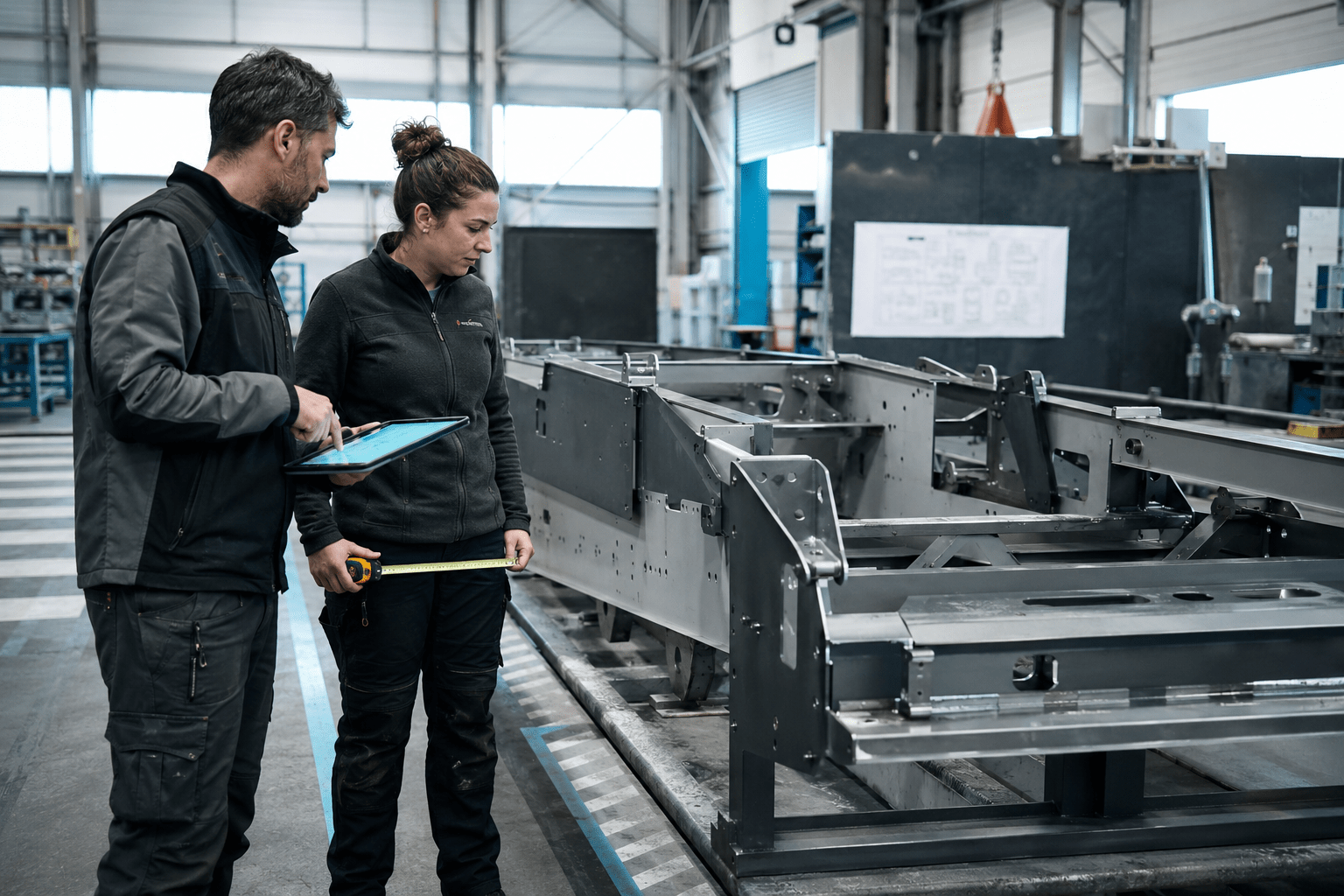
Useful information includes:
- the type of structure;
- its dimensions;
- its mass;
- the load carried;
- the distribution of that load;
- how often it moves;
- the distance traveled;
- the actual duration of a transfer;
- waiting times;
- the number of people involved;
- the material-handling equipment currently used;
- the width of passages;
- the floor surface;
- slopes and potential obstacles;
- the positioning accuracy required on arrival;
- interfaces with workstations;
- expected changes in activity.
This analysis should cover a real cycle under normal operating conditions.
An unloaded demonstration or simplified route does not always represent day-to-day constraints.
The starting question should therefore not be: “Which robot should we buy?”
It should be:
“Which operation needs to become simpler, more consistent or more autonomous?”
Several approaches are possible
There is no single answer for every flow.
Depending on the need, it may make sense to:
- reorganize the route;
- change the production sequence;
- create dedicated handling equipment;
- use a trolley or tow tractor;
- install a conveyor;
- use an AGV or AMR;
- motorize the existing structure;
- automate only part of its movement;
- combine several solutions.
Conveyors, trolleys, tow tractors, AGVs and AMRs each suit specific uses.
The right choice depends in particular on route repeatability, the level of standardization, available infrastructure, space, load and the need for flexibility.
The goal is not to pit technologies against each other, but to select the approach best aligned with the operation.
The FreeMoov approach: start with the structure and how it is used
FreeMoov develops Nodes that can motorize and automate existing industrial structures.
The study therefore does not start with the robot alone. It starts with the structure, load, route and operational objective.
The analysis covers, in particular:
- the geometry of the structure;
- available interfaces;
- the center of gravity;
- the operating environment;
- site constraints;
- the required precision;
- the desired level of assistance or automation;
- how the need may evolve.
This approach can make it possible to retain useful equipment while improving its mobility.
It does not mean every structure can or should be motorized. Feasibility always depends on the mechanical, operational and safety constraints of the project.
Illustrative analysis example
Consider a wheeled frame used to transfer a part between two workstations.
The frame performs its function well. It holds the part in the right position and its tooling remains suitable.
Moving it, however, requires:
- two people to be available;
- several path corrections;
- a waiting area in front of the second workstation;
- precise realignment before work resumes.
In this situation, immediately replacing the frame is not necessarily the first answer.
The analysis can begin with its mobility, guidance, interfaces with the workstations and the possibility of automating all or part of the transfer.
This example is intentionally generic. It does not describe a customer project or a guaranteed outcome.
Checklist: is your structure limiting production?
Use these questions during an on-site observation:
- Is the structure still mechanically functional?
- Does moving it regularly cause a wait?
- Do you have to find a person or vehicle to move it?
- Does a maneuver require several adjustments?
- Do buffer zones exist mainly to absorb transfer delays?
- Does a product changeover make it harder to move?
- Do the load or floor condition substantially affect the maneuver?
- Does the structure remain outside the automated flow?
- Is replacement being considered mainly to solve a mobility problem?
- Have you measured the full transfer time?
This checklist does not produce an automatic score.
It helps organize observations, compare situations and prepare a technical discussion.
A structure does not have to fail to become a constraint
Loss of flow does not always take the form of a breakdown.
It may emerge gradually through waiting, extra maneuvers, buffer zones or workarounds that have become permanent.
Before replacing a still-useful installation, it is worth distinguishing:
- its function;
- its mobility;
- its integration into the flow;
- its level of automation.
The best decision is not always to keep or to replace it.
It is to identify the capability the operation actually lacks.
Is your structure still working, but slowing down operations when moved?
Describe how it is used, its load, environment and intended route. The FreeMoov team can study your constraints before considering a suitable configuration.